I put Middle Earth Journal in hiatus in May of 2008 and moved to Newshoggers.
I temporarily reopened Middle Earth Journal when Newshoggers shut it's doors but I was invited to Participate at The Moderate Voice so Middle Earth Journal is once again in hiatus.

Showing posts with label Technology. Show all posts

Sunday, February 10, 2013

Those People You've Never Heard Of That Changed Your Life

We have all heard of Thomas Edison and Alexander Graham Bell but there are many people who changed our lives that we have never heard of.  A few years ago I wrote about Hiro Moriyasu who developed the digital oscilloscope and the first desktop computer, the Tektronix 4051.  He certainly changed our lives but few have heard of him.  
Today where hear about another such individual, John Karlin of Bell Labs.

A generation ago, when the poetry of PEnnsylvania and BUtterfield was about to give way to telephone numbers in unpoetic strings, a critical question arose: Would people be able to remember all seven digits long enough to dial them?
And when, not long afterward, the dial gave way to push buttons, new questions arose: round buttons, or square? How big should they be? Most crucially, how should they be arrayed? In a circle? A rectangle? An arc?
For decades after World War II, these questions were studied by a group of social scientists and engineers in New Jersey led by one man, a Bell Labs industrial psychologist named John E. Karlin.
By all accounts a modest man despite his variegated accomplishments (he had a doctorate in mathematical psychology, was trained in electrical engineering and had been a professional violinist), Mr. Karlin, who died on Jan. 28, at 94, was virtually unknown to the general public.
But his research, along with that of his subordinates, quietly yet emphatically defined the experience of using the telephone in the mid-20th century and afterward, from ushering in all-digit dialing to casting the shape of the keypad on touch-tone phones. And that keypad, in turn, would inform the design of a spate of other everyday objects.
I am old enough to remember dial phones and party lines where you shared a wire with one or more other numbers.  I also remember  when our home phone number went from CApitol-XXXX to 227-XXXX and the first touch tone phone.  But I'd never really thought about this:

In 2013, the 50th anniversary of the introduction of the touch-tone phone, the answers to those questions remain palpable at the press of a button. The rectangular design of the keypad, the shape of its buttons and the position of the numbers — with “1-2-3″ on the top row instead of the bottom, as on a calculator — all sprang from empirical research conducted or overseen by Mr. Karlin.
The legacy of that research now extends far beyond the telephone: the keypad design Mr. Karlin shepherded into being has become the international standard on objects as diverse as A.T.M.’s, gas pumps, door locks, vending machines and medical equipment.
Touch Tone Key Pad

Tektronix 4051

Tuesday, March 20, 2007

Another Pioneer Dies

In 1965 or 66 I took my first computer course, Fortran. I would spend hours the keyboard of a punch card machine to create a stack on cards about 6 to 8 inches high. These cards would then be placed in a compiler that would create another stack of cards 4 or 5 time bigger that would then be fed to the SUV sized IBM computer. That was my first experience with computers. The driving force of the first programing language for everyone has died.
John W. Backus, 82, Fortran Developer, Dies
John W. Backus, who assembled and led the I.B.M. team that created Fortran, the first widely used programming language, which helped open the door to modern computing, died on Saturday at his home in Ashland, Ore. He was 82.

[....]

Fortran, released in 1957, was “the turning point” in computer software, much as the microprocessor was a giant step forward in hardware, according to J.A.N. Lee, a leading computer historian.

Fortran changed the terms of communication between humans and computers, moving up a level to a language that was more comprehensible by humans. So Fortran, in computing vernacular, is considered the first successful higher-level language.
That same year in order to fulfill a requirement for an upper level humanity I took a philosophy course called Introduction to Boolean Algebra. In 1979 I was working as a manufacturing engineer for Tektronix. The decision was made to make use of the new technological kid on the block, the microprocessor, to make controls for the manufacturing process. Since I had some "computer experience" it was decided that I would learn the assmebly language used to program that early controller. Much to my amazement much of it was that same Boolean Algebra I had learned in that philosophy class more than 15 years earlier.

Saturday, July 23, 2005

Hiro Moriyasu

I like to take a break from politics but I hate to do it with obituaries. I have discussed the passing of exceptional scientists and engineers here before but Hiro Moriyasu is different. I knew and worked with him at Tektronix.

Portland inventor Hiro Moriyasu dies
Hiro Moriyasu, the inventor of the digital oscilloscope and a patent holder for many other technologies, including one of the first personal computers, died in his Southwest Portland home Sunday.

Moriyasu, 70, worked as an engineer at a company he founded up until his death. His 1971 invention, which he developed while working for Beaverton-based Tektronix, improved upon the old analog oscilloscope by allowing the visible image of moving electrons to be saved and documented in digitized form.

"The magnitude of his work was such that everybody else followed to do what Tektronix did," said Leon Orchard, chairman of the board of Ortech Industries who supervised Moriyasu at Tektronix. "He was a brilliant engineer with a gift for understanding what was fundamental and what was not."

In 1974, Moriyasu created one of the first personal computers, the 4051, an invention that caused IBM to take its earlier model off the market, said Luis Navarro, an engineer at Precision Interconnect, a division of Tyco International Ltd. who worked with Moriyasu at Tektronix and at two later startup companies. He added that Tektronix wasn't interested in supplying the consumer market, so it missed the potentially fruitful opportunity to further develop Moriyasu's design.
I worked at Tektronix as a manufacturing engineer in the CRT division. At the time Moriyasu developed the digital oscilloscope and the 4051 computer the best microprocessors were 8 bit which meant only 64K of memory could be addressed. As a result there was little or no memory for video. The solution was the Tektronix direct view storage CRT. The CRT itself was a storage device. Early computer graphics was built around the DVST (direct view storage tube).
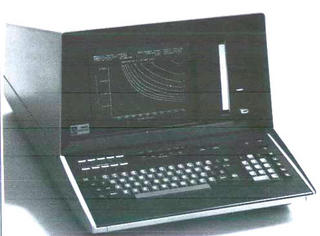

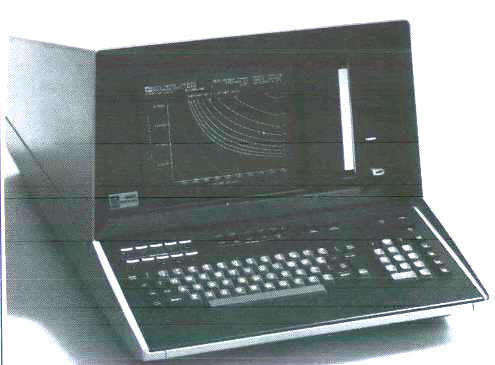
The Tektronix 4051 was the first desk top computer, although it was best if you had two desks since the 4051 filled one of them. Programming was in TEK Basic and programs were stored on a tape drive. The cost in 1975 was $6,000 with 8K of memory.
If Tektronix had chosen to further develop the 4051 it might have been the IBM of today. I believe that one reason they didn't was IBM was our largest customer for the DVST graphic displays.